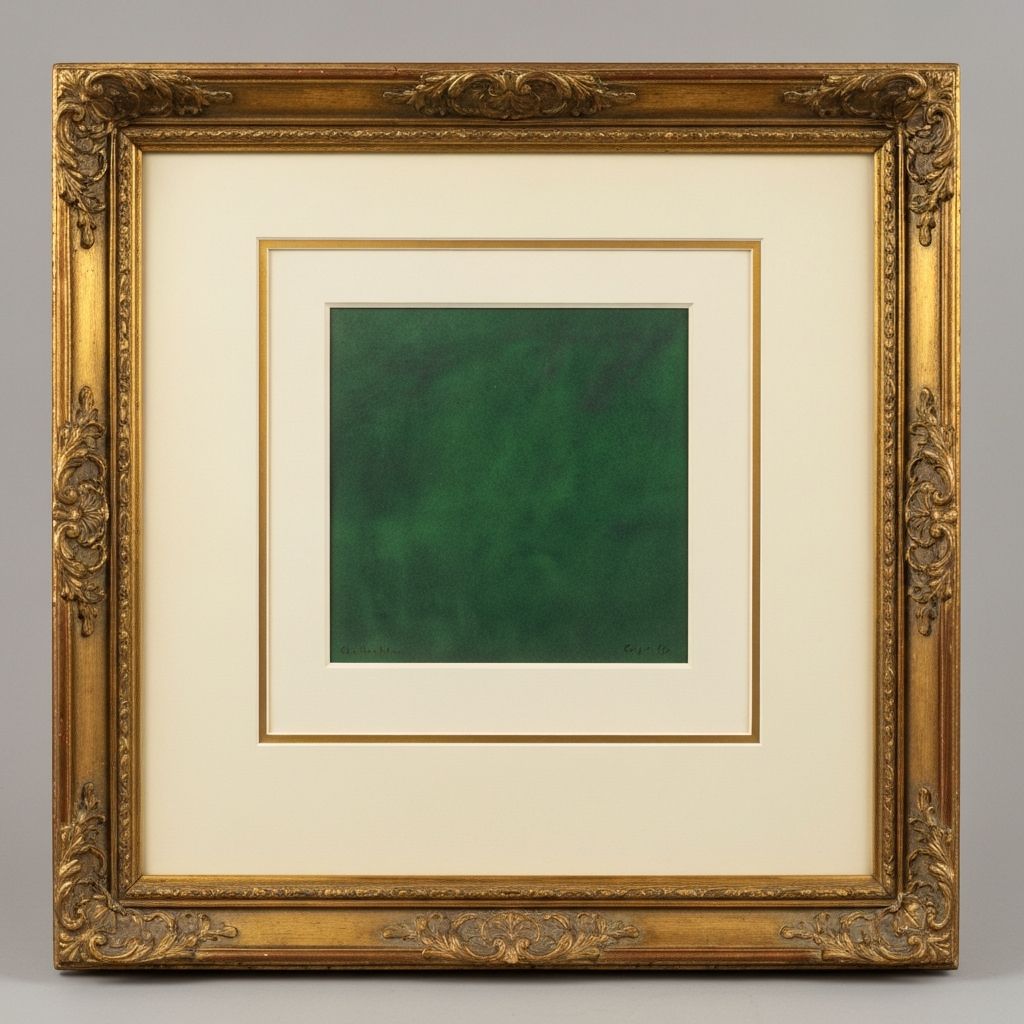
The word "conservation" gets used loosely in framing, to the point where it has almost lost meaning. Some framers advertise "conservation framing" and mean they have used an acid-free mount board. Others mean they have met the full archival standard — every material in the frame tested, every adhesive reversible, every component chosen to last a century without causing harm.
These are very different things, and if you have artwork or objects that matter to you, understanding the distinction is worth the time.
What is conservation framing?
True conservation framing is a set of principles rather than a single method. The core idea is that the framing must not harm the object inside it, now or in the future, and that the object must remain accessible — removable from the frame without damage if needed.
Museums have been applying these standards for decades. The British Museum, the Tate, the National Portrait Gallery — all their works on paper, photographs, and textiles are framed to conservation standard. When a piece goes into a conservation frame, the expectation is that it can be removed fifty years later in exactly the same condition as it went in.
For private collectors and individuals, the same principles apply. If you have an original artwork, an antique print, a significant photograph, or anything irreplaceable, conservation framing is the appropriate standard.
The materials involved
Mount board
Standard mount board — the sort used in most everyday framing — is made from wood pulp and contains lignin and acids. These do not cause immediate damage, but over years and decades they migrate into the artwork, causing brown staining, yellowing, and brittle deterioration at the edges. You will have seen this on old framed prints where the artwork has a brown border exactly matching the mount opening — that is acid burn from the mount board.
Conservation mount board is manufactured from pure alpha-cellulose or cotton, buffered to a neutral or slightly alkaline pH. It will not cause this damage over time. The difference in cost is relatively small — typically £15–30 more for a standard-sized mount — but the protection over decades is significant.
Backing board
The backing board behind the artwork also needs to be inert. Cheap cardboard or standard foamcore release acids and can cause damage from behind. Conservation-grade Fome-Cor or museum-quality board is used in proper conservation framing.
Glass
Ordinary glass transmits ultraviolet light — the primary cause of fading in artwork, photographs, and textiles. UV-filtering glass blocks 97–99% of UV radiation. Museum glass (anti-reflective conservation glass) blocks as much UV as UV-filtering glass and also virtually eliminates reflections, making the artwork much easier to view in any lighting condition.
For conservation framing, UV-filtering glass is the minimum standard. Museum glass is the preferred option for important pieces.
Spacers
In conservation framing, the artwork must not touch the glass. Moisture condenses on the inside of glass — if the artwork is in contact, this causes adhesion, cockling (wavy distortion of paper), and in bad cases mould. Spacers — typically small strips of archival material at the edges of the rebate — create a gap between glass and artwork.
Mounting methods
How the artwork is actually held in place is perhaps the most critical element of conservation framing, and the one where most non-conservation framers fall down.
The conservation standard is reversible mounting — meaning the artwork can be removed from whatever holds it without damage and without residue. The traditional method for works on paper is Japanese tissue hinges: small strips of long-fibered Japanese paper attached with wheat starch paste. These are extraordinarily thin, completely reversible in water, and effectively invisible. The artwork can be released from them decades later with a damp brush, leaving no damage.
Non-reversible methods include: dry mounting (heat and adhesive permanently bonds the artwork to a backing — irreversible and destroys monetary and historic value), spray adhesive, double-sided tape, and most modern pressure-sensitive adhesives. All of these should be avoided for anything of value.
Some framers use polyester film corners or edge strips — archival polyester tabs that hold the artwork at its edges without adhesive. These are suitable for stiffer works and are fully reversible.
When you need conservation framing
The honest answer is: whenever the artwork matters. But some situations make conservation framing clearly necessary:
- Original works of art. Watercolours, drawings, pastels, works on paper. These are irreplaceable. They deserve archival materials.
- Original photographs. Particularly older photographs — prints from the 1950s, 60s, 70s — which are made on paper bases that are particularly susceptible to acid damage and fading.
- Antique prints and maps. A Georgian mezzotint or a Victorian engraving is a historic object. Standard framing can damage it within a generation.
- Documents and manuscripts. Letters, certificates, deeds, anything with historical or personal significance.
- Textiles. Samplers, embroideries, antique fabrics. Conservation standards apply here too, though the mounting methods are different.
- Anything that cannot be replaced. If it was your grandmother's, if it was made by your child, if it is the only copy — it deserves proper protection.
When you probably do not need it
Conservation framing costs more — typically two to three times the price of standard framing for the same piece. For some items, that additional cost is not warranted:
- Reproduction prints on good-quality paper
- Posters and promotional material
- Modern inkjet prints without significant monetary value
- Anything you are framing purely for decoration rather than preservation
The practical question is always: if this were damaged or destroyed, would that be a significant loss? If yes, frame it properly. If no, standard quality framing is fine.
What it costs
Conservation framing typically costs 2–3x more than standard framing for the same piece. For a standard A3 artwork:
- Standard framing: £80–£150
- Conservation-grade framing: £200–£350
For larger or more complex pieces the cost scales with size, but the premium over standard framing remains roughly proportional. The additional cost covers: conservation mount board (more expensive than standard), UV glass (significantly more expensive than float glass), archival backing, and the extra time spent on reversible mounting.
One final thought: having an original artwork re-framed because the previous framing caused damage — acid burn, UV fade, adhesive contamination — is almost always more expensive than paying for conservation framing the first time. The money saved on standard framing is rarely worth the risk.
Related articles

How much does picture framing cost in the UK?
A comprehensive guide to picture framing prices in 2026, from budget options to museum-quality conservation framing — plus tips on where to save and where to spend.
Canvas stretching vs canvas printing: what is the difference?
Confused about canvas stretching and canvas printing? We break down what each process actually involves, when to choose one over the other, and what to expect to pay.
How to find a trusted picture framer near you
What to look for in a professional framer, the questions that separate good craftspeople from bad ones, and the red flags that should make you walk away.