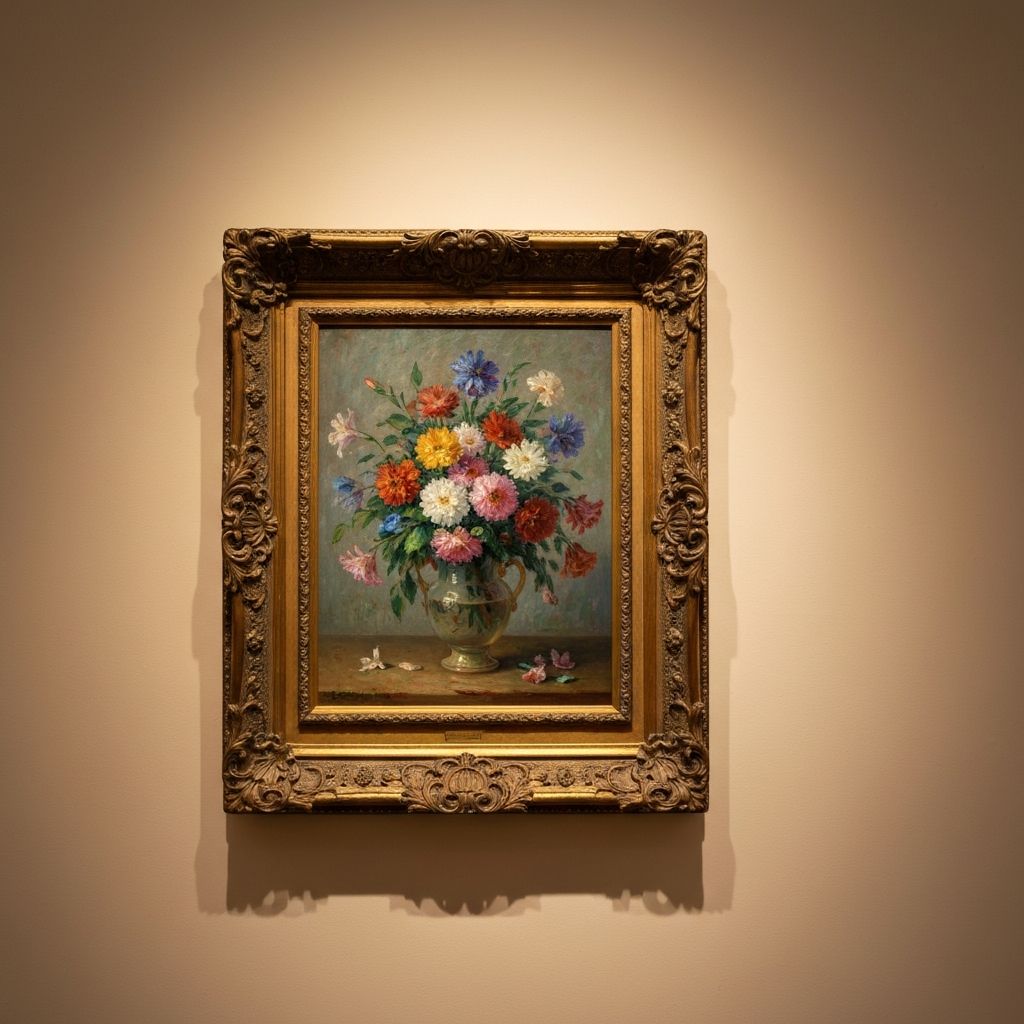
Ask a picture framer how much it costs to frame something and the honest answer is: it depends entirely on what you want. That might sound evasive, but it really is true. The gap between a £40 ready-made frame from a high street shop and a £900 hand-gilded conservation piece from a specialist studio reflects entirely different materials, skills, and processes — not just margins.
This guide breaks down what you are actually paying for at each price point, so you can make informed decisions rather than either overpaying or, worse, skimping on something valuable.
Price overview
For a standard A3 print or photograph framed to a reasonable quality, here is what you can expect to pay in the UK in 2026:
- Budget framing (£40–£80): Ready-made frames from chain stores, basic mount board cut to size. Fine for posters and prints you're not too precious about.
- Mid-range bespoke (£80–£200): Custom-cut frame, proper mount board, standard float glass. A good framer working at this price point will do you proud for most artwork and photography.
- Premium bespoke (£200–£400): Hardwood frame, museum-grade mount board, UV-filtering glass. Where you should be for original artwork, quality photography, or anything that matters.
- Conservation framing (£400+): 100% archival materials throughout, museum glass, reversible mounting. For originals, antique prints, anything irreplaceable.
These are rough guides for A3. Scale up for larger pieces — an A1 canvas or a wide panoramic print might cost double those figures simply because of material quantities and the extra labour involved in handling larger work without damage.
What affects the price
The final quote is the sum of several moving parts. Understanding each one helps you have a more productive conversation with your framer — and means you will know straight away if a quote is suspiciously low.
Size
This is the most obvious factor. More materials, more cutting, more glass, heavier handling. A 30×40cm print and a 100×150cm canvas are completely different jobs. Frame moulding is priced per metre; glass is priced per square metre. A large piece is genuinely just more expensive to frame well.
Frame moulding
The moulding — the profile that forms the frame itself — varies more in price than almost anything else. A plain pine moulding might cost your framer £8 per metre. A figured walnut with a hand-rubbed wax finish might be £60 per metre. A hand-water-gilded gesso profile could be £200 per metre. For a modest A2 frame, you might use 1.8 metres of moulding; for a large canvas, considerably more.
Glass type
Standard float glass costs very little but offers no UV protection and a fair amount of glare. UV-filtering glass costs roughly twice as much but protects against the light damage that fades artwork over years. Museum glass — sometimes called anti-reflective or conservation glass — is optically the clearest, allows virtually no reflection, and offers the highest UV protection. It is significantly more expensive, sometimes adding £80–£200 to a frame, but for original art or valuable photography it is worth taking seriously.
Mount board
The mount (or mat, if you are used to American terminology) sits between the glass and the artwork, providing a visual border and physically separating the two. Standard mount board is fine for prints. Conservation-grade mount board is acid-free and won't yellow or cause acid burn to the artwork over time. For anything original or valuable, conservation board is not optional — it is necessary.
Mounting method
How your artwork is actually attached within the frame matters. Dry mounting (using heat-activated adhesive) is fine for posters but destroys originals and should never be used for artwork you care about. Proper hinging with Japanese tissue and wheat starch paste — the conservation standard — takes longer and costs more, but the work can be removed decades later without damage.
Frame types & costs
The frame moulding market is enormous and the range can be baffling. Here is a rough guide to the main categories:
- MDF and composite profiles (£5–15/metre): Most mass-market frames use these. They can look fine, especially in contemporary painted finishes, but they are not as durable as solid wood and the corners can chip over time. Perfectly acceptable for everyday prints.
- Standard hardwood (£15–40/metre): Solid oak, ash, walnut, or beech profiles. Noticeably better quality. Will outlast MDF by decades. Available in a wide range of natural and painted finishes.
- Premium hardwood (£40–80/metre): Figured grain, more complex profiles, hand-rubbed finishes. The difference in feel and appearance compared to standard hardwood is real — though whether it is worth it depends on the artwork and its setting.
- Hand-finished profiles (£80–150/metre): Lacquered, distressed, gilded over composition gesso, or painted by hand. Each frame is a slightly unique object.
- Water-gilded frames (£150–300+/metre): The traditional craft — gesso applied in multiple coats, burnished, then 23-carat gold leaf applied by hand. Time-consuming, extraordinarily beautiful when done well, and priced accordingly.
Choosing the right glass
Glass choice is probably the area where people most often get it wrong — usually by underestimating how much UV damage matters. Artwork fades. Photographs yellow. Textiles bleach out. All of this is caused primarily by ultraviolet light, which comes not just from direct sunlight but from fluorescent and LED lighting too.
Standard glass blocks roughly 45% of UV. UV-filtering glass blocks 97–99%. For a print you paid £20 for, standard glass is fine. For an original watercolour, a signed limited edition, or a photograph you care about, the extra cost of UV glass is genuinely worthwhile — think of it as insurance.
Museum glass (brands like Tru Vue Museum Glass or Artglass AR70) goes further still: optically clear, virtually no reflection, and the highest UV protection available. If you have ever looked at a framed piece and struggled to tell whether there was glass in it, that is museum glass. It costs significantly more — expect to add £80–£200 to a frame — but for the right piece in the right setting it is remarkable.
Hidden costs to watch for
A few things that can add to a quote unexpectedly:
- Backing boards: Often not included in headline prices. A good framer uses a proper backing board — Fome-Cor or similar — rather than cheap cardboard. Ask what is included.
- Hanging hardware: D-rings, wire, wall plates. Small cost but worth confirming.
- Collection and delivery: If you cannot transport a large canvas, collection charges vary widely. Some London framers charge £30–60 per trip; others include it in larger orders.
- Rush charges: Needing a frame back in a week rather than the standard two typically adds 20–30% to the cost.
- Box frames and deep rebates: Objects, textiles, or three-dimensional items require special frames and significantly more time to complete.
Getting the best quotes
The single most important thing you can do before committing to a framer is ask for an itemised quote. Not "how much to frame this?" but "can you break down the cost of the moulding, glass, mount, and labour separately?" A framer who cannot or will not do this is one to treat with caution.
When comparing quotes, make sure you are comparing like for like. A £90 quote and a £180 quote for the same piece are very different things if one includes UV glass and conservation mount board and the other does not.
Get two or three quotes for anything significant. Prices vary considerably between framers — not just because of quality differences, but because of overheads, sourcing, and individual pricing decisions. A framer in a converted railway arch in South London may well be 30% cheaper than one on the high street of a prosperous town, while doing equal or better work.
At TrueSquare, every framer provides transparent, itemised quotes — so you know exactly what you are getting before you commit to anything.
Related articles
Canvas stretching vs canvas printing: what is the difference?
Confused about canvas stretching and canvas printing? We break down what each process actually involves, when to choose one over the other, and what to expect to pay.
How to find a trusted picture framer near you
What to look for in a professional framer, the questions that separate good craftspeople from bad ones, and the red flags that should make you walk away.
Football shirt framing: everything you need to know
A complete guide to framing football shirts and sports memorabilia — from choosing the right display method to protecting signed items and what you should expect to pay.